ALL IN’s First Progress Report summarizes ALL IN For Health’s many accomplishments to date—including making nearly 650,000 contacts with parents, students, and school employees across California about their health coverage options. In this new report, learn how education leaders, like you, made a difference, and find out how ALL IN For Health will help you with health coverage throughout the 2014–2015 school year.
In 2011, the State of California established an “audacious goal” to provide an electronic personal health record (PHR) to every child and youth in foster care that would enable information sharing and linkages across data systems, providers, and agencies that serve them. In 2012, the California Health eQuality (CheQ) program awarded a small planning grant to The Children’s Partnership to pull together stakeholders, review the research and current initiatives, and develop a Strategic Plan to help California policymakers, funders, public officials, and advocates chart a path forward to implement this “audacious goal.”
This report highlights the Strategic Plan and the progress made since it was completed in 2013. Consistent with the Plan’s recommendations, a variety of public and private partners, including The Children’s Partnership, have been implementing two county demonstration projects to test two models for providing an electronic personal health record to children and youth in foster care, measure the impact of the PHR on their lives, and generate lessons learned for scaling the model to other counties and/or statewide. Additionally, The Children’s Partnership is convening a variety of stakeholders to brainstorm ideas for incorporating a link to a PHR into California’s new Child Welfare Services data system (CWS/NS), now under design. In the near future, The Children’s Partnership will initiate a learning community of counties currently engaged in electronic information exchange to share lessons learned and best practices for implementing a PHR for children and youth in foster care.
Additional Resources:
The California Children’s Dental Disease Prevention Program (CCDDPP) was a highly successful program that helped to improve the oral health of California’s underserved children. Between 1980 and 2009, CCDDPP provided school-based oral health prevention services to hundreds of thousands of underserved children. Funding for the program was suspended indefinitely in 2009.
With dental disease being the number one chronic health problem among children in California and nationally and schools being the ideal place to reach children with necessary preventive dental care, it’s time to restore funding to CCDDPP.
WEBINAR: School-Based Telemedicine
Learn What’s Involved, How to Get Started and the Secrets to Successful School-Based Telemedicine Programs.
AMD Global Telemedicine, MY Health-e-Schools and The Children’s Partnership organization have come together to share our knowledge on how to implement, run and sustain an effective school-based telemedicine program.
Listen to this archived webinar to hear first hand from MY Health-e-Schools about how they started their program, lessons learned along the way and how they have managed to sustain success. In addition, hear from The Children’s Partnership about school-based telemedicine programs from across the country, lessons learned and the benefits of school-based telemedicine.
This issue brief summarizes findings from a study that illustrates the difficulty parents of children enrolled in Medi-Cal often experience in accessing dental care for their children. The study mimicked the online process that parents can use to try to find a dentist who treats Medi-Cal patients and found the experience often exasperating.
Specifically, it looks at the accuracy and reliability of the State’s online resource—the national InsureKidsNow.gov website—for identifying dentists who treat children enrolled in Medi-Cal, and assesses families’ experiences when calling identified dentists.
This brief lays out the case for investing in systems that enable electronic information exchange for children and youth in foster care, reviews existing efforts underway in states and communities, identifies specific elements that serve this population most effectively, and discusses steps that state advocates can take to establish an integrated electronic record of care for foster children and youth in their state.
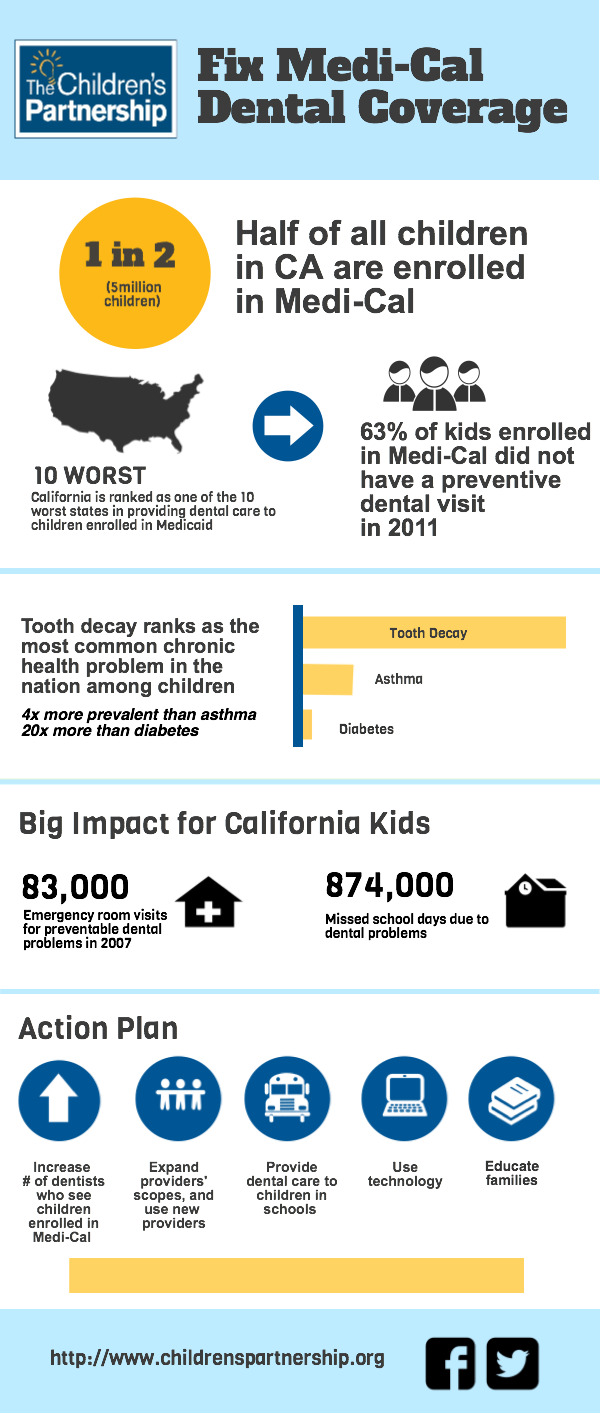
Medi-Cal’s dental program will soon provide dental services to about 50 percent of California’s children. Yet, the program has proven to be inadequate to meet their needs. This issue brief spotlights stories of children enrolled in Medi-Cal trying to access dental care. The brief highlights the challenges facing Medi-Cal in providing dental care to children, examines the State’s efforts to address these problems, and provides an action plan to help the program serve its growing number of enrollees.
Download the Fix Medi-Cal Dental Coverage infographic
Can Game Companies Help America’s Children?
The report includes the results of a yearlong study of the $25.1 billion digital game industry and provides a focused look at the demographics of gamers, trends in social gaming and virtual goods, and the potential of cause partnerships to benefit child health and education.
Telehealth refers to the use of technology to provide health care at a distance. The important and increasing role of telehealth in the delivery of health care has been recognized for several decades. Although there are fewer reports on the use of telehealth to deliver oral health services, evidence is emerging that these technologies can enhance the ability of the oral health delivery system to reach vulnerable and underserved populations.
Just six months after the Affordable Care Act (ACA) law was signed on March 23, 2010, California children gained expanded health coverage and new protections that will ensure that more children have the health care they need to grow up healthy and ready to learn. Health care reform is already helping millions of California children and their families – and even more will benefit once the law is fully in place in 2014.