In 2026, the Children’s Partnership is co-sponsoring the Peer Employment Equity Reform (PEER) Act, AB 2126, as part of our children’s health equity policy agenda. The PEER Act, authored by Assemblymember Sade Elhawary (D – Los Angeles), is a step forward for current and former foster youth to get job opportunities as peer mentors.
Peer mentors are mental health workers. They know what it’s like to grow up in foster care. They have first-hand knowledge of how to best support foster children and can model success for system-involved youth and families.
Mentors with lived experience in foster care are a valuable resource for families in the child welfare, behavioral health, and juvenile justice systems. Research shows that peers improve engagement, strengthen stability, and support positive outcomes like reunification and staying in school.
Current policies often delay or deny employment as peer mentors to current and former foster youth, often due to prior nonviolent offenses. This means that job candidates, who can relate to and impact current foster youth through their powerful lived experiences, are often denied jobs they are qualified for. Current policy disproportionately keeps former foster youth from getting hired into positions where they can make a critical impact and also improve their own lives. Community-care licensed facilities must follow background check rules that can take up to 14 months to complete. Most people cannot wait that long for employment.
“For former foster youth who have been let down by family, caretakers, society, and who also carry trauma [and] shuffled through systems – this could be a lifeline, a hope that cannot be measured.”
– Rudy Santo Castro, Licensed Clinical Social Worker & former foster youth
Youth in foster care, especially youth of color, experience higher rates of trauma. They are also more likely to face criminalization rather than having their needs met with real support.
Despite the overwhelming majority of offenses being non-violent responses to trauma, applicants with a criminal record must go through a lengthy exemption review process. This delay especially affects foster youth, many of whom have nonviolent offenses tied to trauma or instability during adolescence.
The current process is keeping qualified peer mentors from providing needed mental health support to others who have similar lived experience.
AB 2126, authored by Assemblymember Sade Elhawary, establishes automatic background check exemptions for current and former foster youth to become peer mentors. This bill creates a pathway to employment and expands opportunities for system-involved youth, particularly youth of color, who are disproportionately impacted by low-level criminal records compared to their white, non-system-involved peers.
Support Peer Mentorship!
AB 2126 – PEER Act (Asm. Sade Elhawary)
Recent Updates: The Peer Employment Equity Reform (PEER) Act passed the California Assembly Human Services Committee with unanimous support on April 15, 2026.
The PEER Act reduces employment barriers and expands opportunities for justice system-involved youth, particularly youth of color, who are more often impacted by low-level criminal records compared to their white, non-system-involved peers.
Bill Co-sponsors:
- Alliance for Boys and Men of Color
- County Welfare Directors Association of California
- California Alliance of Child and Family Services
Resources
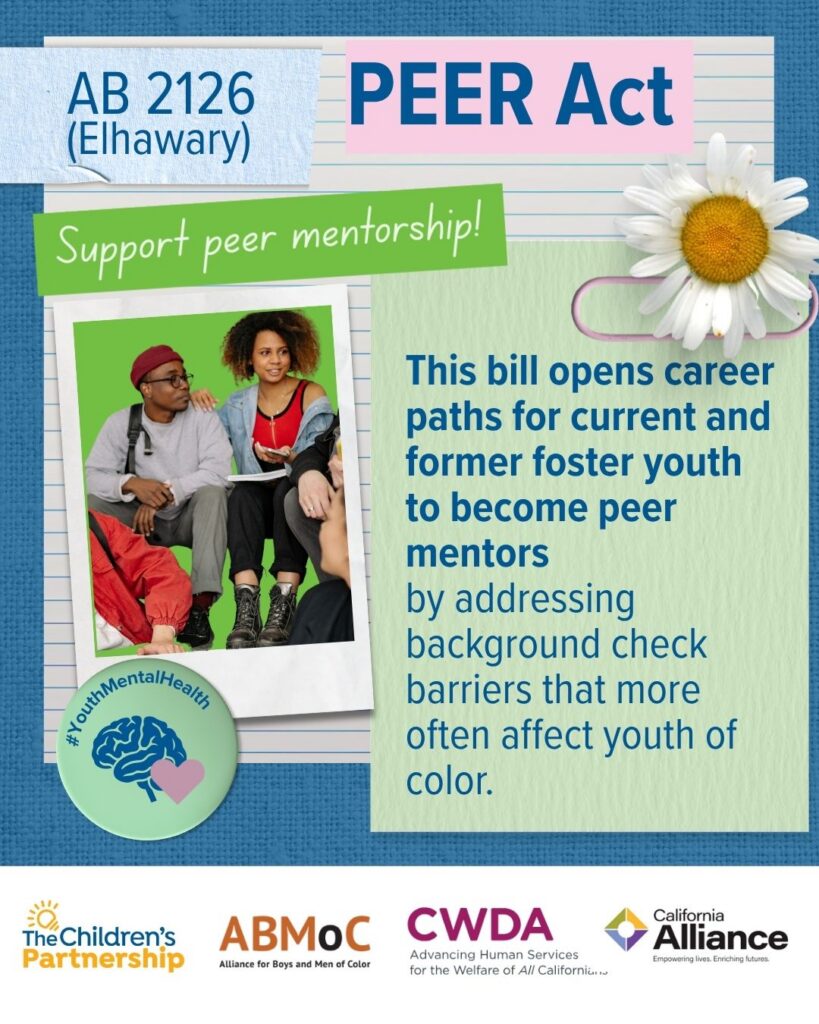
Use our AB 2126 social media toolkit to get graphics and images to share on Instagram, Facebook, LinkedIn, Twitter, and BlueSky.
CONTACT: Sarah Dar, Vice President of Policy and Advocacy, The Children’s Partnership, sdar@childrenspartnership.org
